
Preparation Before Robotic Surgery
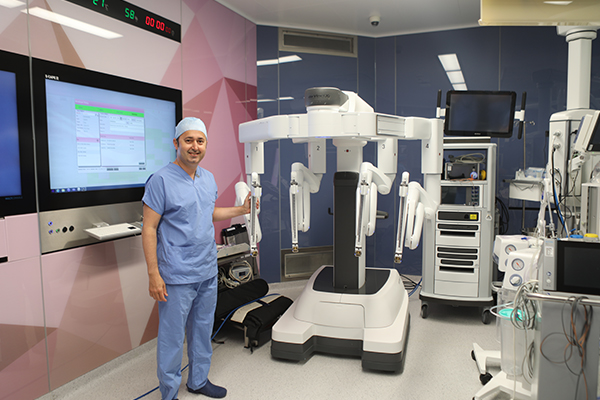
As before all operations, before robotic surgery too some blood tests, a chest X-ray and an electrocardiogram (ECG) are performed, after which an evaluation is made by the anaesthesia specialist and it is investigated whether there is any condition preventing the operation. Then, after 6 hours of fasting from food and drink before the operation, the patient is taken into the operating theatre.
As in laparoscopic surgery, after the patient has received anaesthesia she is placed in the lithotomy position (the delivery position). Her arms are then positioned so that they are tucked in alongside the body. After the patient has been sterilely prepared and draped, a urinary catheter and, inside the uterus, the instrument we call a manipulator, which allows the uterus to be moved during the operation, are placed.
First an incision of about 8 mm is made in the navel and an instrument we call a trocar is inserted. With this instrument the inside of the abdomen is inflated with carbon dioxide. At this point the patient is placed in a head-down position. Then 8 mm incisions are made at the other points suitable for the robot’s arms and trocars are inserted. The section containing the robot’s arms is then brought close to the patient
The robot’s arms are placed inside the patient’s abdomen through these instruments we call trocars. This procedure is called ‘docking’. One of these arms carries the camera that provides a three-dimensional, high-resolution image. The other arms carry the instruments (surgical scissors, needle holder, tissue grasper, tissue cutter, etc.) specialised according to the movements the surgeon wishes to make in the surgical field. Thanks to these special instruments, the surgeon’s movements are carried out simultaneously in the surgical field. After this procedure the surgeon moves to the section called the console, from which the operation will be performed.
Let’s decide on the right approach for you together
After your examination and imaging, we will discuss clearly whether robotic surgery is suitable for you.