
3D Operations With Robotic Surgery!
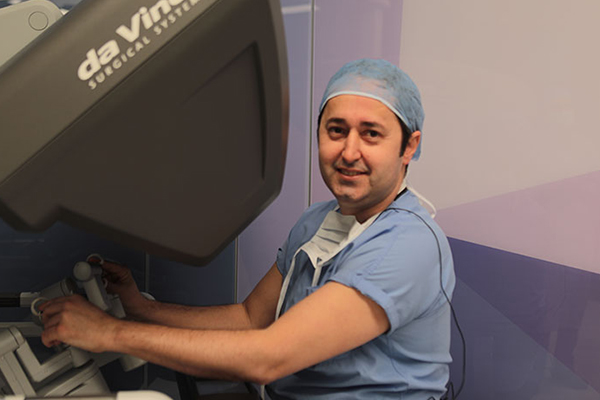

Operations are performed at Acıbadem Altunizade Hospital with the da Vinci robotic surgical system.
Request an AppointmentWith this method, also known as the da Vinci robot, the doctor sits at a console from which the arms of the robot are controlled. Only the surgeon can control the arms of the robot. Another surgeon standing at the patient’s side assists the surgeon at the console. In robotic surgery the surgeon gives commands to the robot, and the arms on the patient cart carry out the operation by reproducing every command received from the surgeon exactly and simultaneously.
The advantage of robotic surgery is that, thanks to the capabilities of the robot, the surgeon can see the operating area far more clearly, closely and in three dimensions than with the naked eye, and tires less because of working in a seated position.
Is the Robot Performing the Operation?
One of the questions we are asked most often is ”in robotic surgery, is the robot performing the operations or the surgeon?”. Our answer is very clear; of course the surgeon is performing them. The robotic equipment makes the surgeon’s work considerably easier. As a result, difficult operations can be performed more easily.
Robotic surgery is a computer-assisted system in which the surgeon works from the surgeon console located next to the patient in the operating theatre, using the arms on the patient cart that are modelled on the human wrist. Although the first question that comes to mind when robotics is mentioned is ‘Is a robot performing the operation?’, the operation is performed by a surgeon.
It Eliminates Hand Tremor!
Robotic surgery is a type of minimally invasive surgery. Minimally invasive surgery means operating on the patient with special surgical instruments inserted through incisions smaller than 1 cm, causing less damage to the surrounding tissues, instead of operating through a large incision. In robotic surgery there is a camera arm and mechanical arms to which the surgical instruments are attached.
The instruments on these arms consist of small tools that have seven degrees of freedom of movement. Thanks to a system called ‘endowrist’, the tips of these instruments can rotate 540 degrees around their own axis. At the same time, they can follow the wrist movements of the human hand.
In robotic surgery, the instruments do not register any possible hand tremor during the operation and never go beyond the surgeon’s commands.
It Increases the Chance of Success of Operations
The surgeon follows the instruments and the camera from a console located in the operating room. In open surgery there are situations in which the surgeon’s hand and instruments cannot reach, or in which they would damage the surrounding organs. With robotic surgery, however, this problem is eliminated. In such situations the robot, which works like an artificial hand, transfers the movements of the surgeon’s hand at the console exactly to the inside of the body and increases the chance of success of the operation.
Robotic surgery, which has been in active use in Turkey for about 10 years, is a method applied on the basis of minimally invasive laparoscopic surgery.
There are approximately 4,000 robotic surgery systems in use worldwide. More than 5 million operations have been performed successfully with the da Vinci robot to date. There are 34 robotic surgery systems in Turkey. They are used intensively in public, private and university hospitals.



Let’s decide on the right approach for you together
After your examination and imaging, we will discuss clearly whether robotic surgery is suitable for you.