
3D Surgery With a Low Risk of Infection
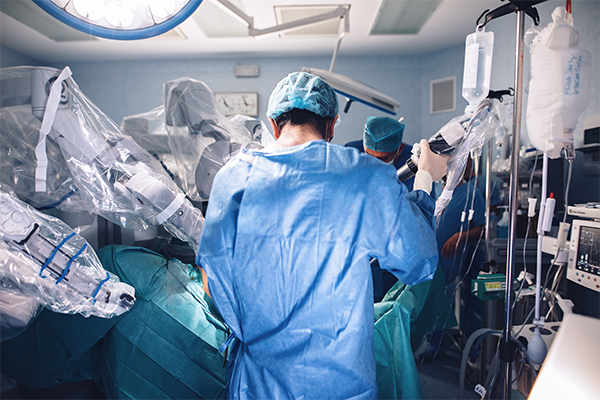

Operations are performed at Acıbadem Altunizade Hospital with the da Vinci robotic surgical system.
Request an AppointmentAfter the da Vinci surgical system received FDA approval in 2005 for use in gynaecological diseases, robot-assisted minimally invasive operations began to spread very rapidly around the world.
Similarly to conventional laparoscopic operations, robotic surgery achieves improved perioperative outcomes together with a reduction in the patient’s hospital stay after the operation and a higher-quality recovery process.
Robotic surgery significantly improves aspects that are limited in the classic laparoscopic method, such as two-dimensional vision, camera sensitivity, the restricted range of movement for laparoscopic instruments and the surgeon’s poor ergonomic position. Along with these, this robot-assisted approach also reduces the risk of the patient experiencing complications during or after the operation to a minimum.
Minimum Risk of Infection
According to the research carried out, robot-assisted operations have many advantages over open methods. Less blood loss occurs with the robotic surgical method, which reduces the patient’s need for blood during the operation.
In addition, the rate of complications such as deep vein thrombosis, infection, lymphocele, haematoma and anastomotic leakage is much lower than in open operations and laparoscopic operations. Because the incision made for the operation is very small and because the patient undergoes minimal intervention in a minimally invasive manner, adverse situations that might occur, such as bleeding or infection, can easily be prevented.
After Surgery With Robotic Surgery
In operations where robotic surgery is preferred, the postoperative process is considerably more comfortable than with other operations and recovery is short. Because the patient’s body undergoes the least possible intervention (unnecessary intervention and movement are kept to a minimum), the recovery process takes place very quickly.
According to the research carried out in gynaecological operations, the rate of second-degree complications in the early and late period after operations performed with robotic surgery has been determined as 2.9%. These complications, which are seen as urinary tract infection, pelvic inflammation or wound site infection, are regarded as complications that are seen after every operation and are treated within a short time with antibiotics. However, they are seen quite rarely.
The rate of third-degree complications has been reported as 0.7%. For this reason, robot-assisted gynaecological operations are regarded as very safe.



Let’s decide on the right approach for you together
After your examination and imaging, we will discuss clearly whether robotic surgery is suitable for you.